If you've ever opened your accounting software, seen three reports with intimidating names, and quietly closed the tab, you're in good company. Most small-business owners can read their bank balance fine but freeze in front of a balance sheet. The good news is that the three core financial statements aren't an accounting exam — they're three different camera angles on the same business, and once you know what each one is pointing at, they become genuinely useful.
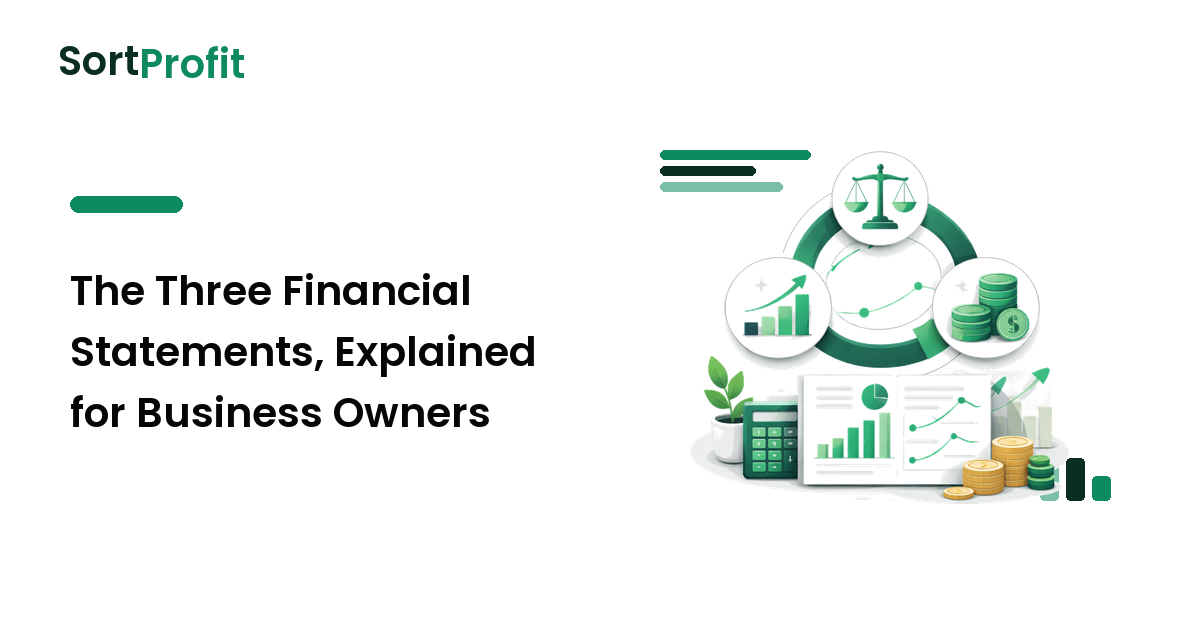
Here's the takeaway up front: the income statement tells you whether you made a profit over a period, the balance sheet tells you what you own and owe at a single moment, and the cash flow statement tells you where your cash actually went. No single one tells the whole story — but read together, they answer almost every financial question you'll have about your business. This guide walks through each in plain English, with round-number examples, and shows how the three connect.
Why three statements instead of one
It would be convenient if a single number told you how the business is doing. It can't, because "how are we doing?" is really three separate questions. Are we profitable? Are we solid — do we own more than we owe? And are we liquid — do we have cash when we need it? A business can be profitable on paper and still run out of money, or sit on a healthy bank balance while quietly sliding into debt. Each statement was designed to answer one of those questions, which is exactly why accountants keep all three.
Think of it like checking on a person's health. The income statement is the fitness tracker showing performance over the month. The balance sheet is the snapshot photo taken today. The cash flow statement is the record of money moving in and out of their wallet. You wouldn't judge someone's health from only one — and you shouldn't judge a business that way either.
The income statement: did we make a profit?
The income statement — also called the profit and loss statement, or P&L — covers a period of time: a month, a quarter, a year. It starts with revenue at the top and subtracts costs in layers until you reach the profit at the bottom. That top-to-bottom shape is why people talk about the "top line" (revenue) and the "bottom line" (net profit).
A simplified monthly P&L for a small services business might read:
- Revenue: $40,000
- Cost of goods sold (COGS): $16,000 → Gross profit: $24,000
- Operating expenses (rent, salaries, software, marketing): $18,000 → Operating profit: $6,000
- Interest and taxes: $1,500 → Net profit: $4,500
Reading it is a matter of watching each layer as a share of revenue, not just the final figure. Is gross profit healthy before overheads? Are operating expenses creeping up faster than sales? The income statement is where pricing and cost discipline show up first, which is why it's usually the statement owners look at most often.
One thing it does not tell you: whether that $4,500 profit is sitting in your bank account. It almost certainly isn't, and that gap is what the third statement exists to explain.
The balance sheet: what we own and owe
If the income statement is a video of the period, the balance sheet is a photo taken on one specific day — usually the last day of the month or year. It has three parts, and they're bound together by one rule that always holds:
Assets = Liabilities + Equity
- Assets are what the business owns or is owed: cash, money customers owe you (accounts receivable), inventory, equipment.
- Liabilities are what the business owes others: supplier bills (accounts payable), loans, taxes due.
- Equity is what's left for the owners after liabilities are subtracted from assets — the business's net worth.
A small example snapshot:
- Assets: Cash $12,000 + Receivables $8,000 + Equipment $20,000 = $40,000
- Liabilities: Payables $6,000 + Loan $14,000 = $20,000
- Equity: $20,000
And $40,000 = $20,000 + $20,000, so it balances — which is where the name comes from. The balance sheet answers the "are we solid?" question. A useful quick read is whether your short-term assets (cash and receivables) comfortably cover your short-term liabilities (bills due soon). If they don't, you may be heading toward a cash squeeze even while the P&L looks fine.
The cash flow statement: where the money actually went
This is the statement most owners skip, and it's often the most revealing. The cash flow statement explains why your profit and your bank balance disagree. It takes the period's activity and sorts every movement of cash into three buckets:
- Operating activities — cash from the day-to-day business: customers paying you, you paying suppliers and staff.
- Investing activities — cash spent on or received from longer-term assets, like buying equipment.
- Financing activities — cash from loans, repayments, or owner contributions and withdrawals.
Why does this matter? Because profit is recorded when a sale is made, but cash arrives when the customer actually pays. Sell $40,000 in a month but collect only $30,000, and the income statement shows the full sale while your cash position tells a tighter story. The cash flow statement reconciles the two, line by line, so you can see exactly where the money went — into unpaid invoices, new equipment, or a loan repayment. Managing that timing gap deliberately is its own discipline; our cash flow guide covers how to forecast and protect it week to week.
How the three statements connect
The real power comes from seeing the statements as one linked system rather than three separate reports. Two connections are worth holding in your head:
- Net profit flows from the income statement into the balance sheet. The profit you earn over a period increases the owners' equity. Earn $4,500 in profit and reinvest it, and equity rises by roughly that amount — the period's performance becomes part of the snapshot.
- Cash on the balance sheet is explained by the cash flow statement. The change in your cash balance from the start of the period to the end is exactly what the cash flow statement breaks down. It's the bridge between the two snapshots.
Put simply: the income statement shows performance, the balance sheet shows position, and the cash flow statement explains the change in cash between two balance sheets. Read in that order — profit, then position, then cash — and a confusing pile of numbers turns into a coherent story about your business.
A simple monthly habit
You don't need to be an accountant to benefit from this; you need a routine. Once a month, pull all three statements from your bookkeeping software and read them together, in that order. Glance at the P&L for the trend in each margin layer, the balance sheet for whether short-term assets cover short-term bills, and the cash flow statement for where cash actually moved. Fifteen minutes a month builds a feel for the business that no single dashboard number can give you.
A note on limits: this guide is about reading your statements to make better decisions, not about tax treatment, how to classify a specific transaction, or compliance. Those depend on your jurisdiction and circumstances, so bring questions like that to a qualified accountant who can look at your actual books.
Frequently Asked Questions
Which financial statement is most important? None on its own — they answer different questions. If forced to start with one, most owners get the most day-to-day value from the income statement, but it's misleading without the cash flow statement to show whether that profit turned into cash.
What's the difference between the income statement and the cash flow statement? The income statement records revenue and costs when they're earned or incurred, regardless of when money changes hands. The cash flow statement tracks only actual cash moving in and out. That's why a profitable month can still show falling cash.
Why does my balance sheet "balance"? Because of the accounting rule that everything the business owns (assets) is funded either by what it owes (liabilities) or by the owners' stake (equity). The two sides describe the same value from two angles, so they always equal each other.
How often should I look at my financial statements? Monthly is a practical rhythm for most small businesses — frequent enough to catch a slipping margin or a building cash squeeze early, without becoming a chore. Reviewing all three together matters more than reviewing any one of them often.
Do I need accounting software to produce these? It helps a great deal and most packages generate all three automatically, but the concepts hold even if you start in a spreadsheet. The skill that pays off is reading them, not the tool that prints them.
Bring It Together
The three financial statements stop being intimidating the moment you know what each one is for: the income statement for profit over a period, the balance sheet for what you own and owe today, and the cash flow statement for where your money actually went. Read them in that order, once a month, and you'll spot problems while they're still small and easy to fix.
Pull your three statements this month and read them together — then sort steadier profit with SortProfit. Explore more guides at sortprofit-business.com.